Subscribe

Powered By

Free XML Skins for Blogger

Powered by Blogger

Tampilkan postingan dengan label Allies. Tampilkan semua postingan

Minggu, 06 Desember 2009

T-34


The T-34 was by far the best tank design in World War 2. In addition to having an excellent combination of firepower, armor, mobility, and shape, its superb technical design, which emphasized simplicity and durability, made it possible to mass produce it in enormous numbers, and gave it very high field and combat reliability, two critical attributes which the advanced German tanks lacked. It was the main war winning weapon of Russia in World War 2.
The T-34 was a medium tank which evolved from a series of pre-war Russian light tanks, which were designed for very high speed (53mph with tracks, and over 60mph in good roads without tracks!!) and long travel range, features which made them a formidable weapon for fast advances very deep into enemy territory, but they severely lacked firepower and armor, so they were not suitable as main battle tanks. Some modern wheeled military vehicles armed with powerful anti tank missiles and machine guns can be regarded as more successful descendants of this type of fighting vehicle.
As a result of the need for an all-purpose main battle tank, the T-34 was developed as a medium tank descendant of those fast light tanks, gradually evolving from their superb technical design, but designed to be a capable main battle tank. The T-34 was lower in height (8ft) than German and American tanks, which was better in using the terrain for taking cover and make it a smaller target to hit. It had sloped armor in both the front and side hull and the turret, which made it harder to penetrate, and of course it had a powerful 76mm gun, which was then a large caliber, and sufficiently thick armor. During World War 2 the gun of the T-34 was upgraded to a more powerful long-barrel 76mm gun and later to 85mm gun, to keep up with the advances in German tank guns and armor.
Initial production and deployment of the T-34 was before the German invasion of Russia. Small numbers of T-34 tanks participated in a series of border battles between Russian and Japanese forces in the far East in early 1941, just three months before the German invasion to Russia.
Both the new T-34 tank and Zhukov, who was later Russia's top military commander in World War 2, made their impressive early debut there, in the far East. Both were noticed and reported by the Japanese, but the Germans ignored those reports and were therefore shocked when they met the first T-34 tanks in combat later that year when they invaded Russia. The Germans so appreciated the performance of the T-34 that when the German military discussed the development of their next tank, the Panther, one of the suggested designs was simply a German copy of the T-34.
There were still small numbers of the new T-34 when the invasion began, and the rapid German advancement so deep into Russia, as far as Moscow, forced the Russian industry, which already lost countless factories, to an unprecedented operation of literally moving its entire remaining military industry factories over 1000 miles further East, to Siberia, to avoid losing it to the advancing Germans.
In those newly built factories, Russia's military industry restored and far exceeded its pre-war mass production capacity. The furious motivation of the Russian production workers to stop the terribly cruel German invaders which were more brutal than Russia's own brutal Communist regime, and the desperate draconic measures of the Russian regime itself, in which being late to work in a factory during the war could result in 10 years imprisonment, gave the wartime Russian military industry the high efficiency that Communism never reached before or after World War 2. In wartime Russia, workers and soldiers alike were motivated by the desire to revenge and the fear of draconic punishments, and were paid in food, which soldiers and workers received while the rest of the population starved severely during the war.
The immense production rate of the T-34 was further boosted by the fact that massive American and British material support enabled the Russian war industry to focus all its effort on the production of a small number of main weapon systems, while other greatly needed equipment, such as trucks and jeeps, field rations and even some aircraft types, were supplied in large numbers by the western allies.
So after the initial tremendous defeats in 1941 which cost Russia millions of soldiers and a huge lost territory, since mid 1942 the Russian army was equipped with rapidly increasing numbers of T-34 tanks which matched the German tanks and increasingly outnumbered them.
Since late 1942, in the late stages of the great battle of Stalingrad, and then in the huge tank battle in Kursk in mid 1943, and until the end of the war, T-34 tanks in ever increasing large numbers, outnumbered and crushed the German tanks, and pushed the German invaders all the way back to Berlin, serving as one of the main war winning weapons of World War 2.
The T-34 was a medium tank, weighed 26 tons. It had a crew of four, it had a good speed of 55kmh (34mph) and a range of 115 miles. During the late stages of the war, the Russian army perfected its mobility so much that tanks were sometimes refueled while still driving forward, without stopping, and the Russian infantry used to keep pace with the advancing tanks simply by riding on them from one battle to the next.
Some T-34 tanks are apparently still being used by some military forces even today, and the generations of Russian tanks developed since World War 2, which were produced in vast numbers during the cold war and still used by many armies, are direct descendants of the T-34, the best tank in World War 2.

sumber:2worldwar2.com

Minggu, 15 November 2009

C-47 Skytrain/Dakota


The DC-3 did not go unnoticed by one of Douglas's oldest customers -- the U.S. Army.
The military career of the Douglas DC series began in 1936 when the Army Air Corps ordered a pair of DC-2s under the designation C-32. A contract followed for 18 DC-2s in the C-33 freighter configuration and two more as C-34 staff transports. Then, in 1937, the Army ordered a plane built to its own specifications. It was a hybrid design that combined the fuselage of the DC-2 with a DC-3 tail. This was the sole C-38 prototype and it led to 35 production versions called the C-39. The C-39 represented the first serious effort by the Army to establish an airlift capability.
By 1941 the old Air Corps had been transformed into the Army Air Forces, and it selected a modified version of the DC-3 -- the C-47 Skytrain -- to become its standard transport aircraft. A reinforced fuselage floor and the addition of a large cargo door were the only major modifications. Other changes included the fitting of cargo hooks beneath the center wing section and the removal of the tail cone to mount a hook for towing gliders.
As a supply plane, the C-47 could carry up to 6,000 pounds of cargo. It could also hold a fully assembled jeep or a 37 mm cannon. As a troop transport, it carried 28 soldiers in full combat gear. As a medical airlift plane, it could accommodate 14 stretcher patients and three nurses. Seven basic versions were built, and the aircraft was given at least 22 designations, including the AC-47D gunship, the EC-47 electronic reconnaissance aircraft, the EC-47Q antiaircraft systems evaluation aircraft and the C-53 Skytrooper.
Every branch of the U.S military and all the major allied powers flew it. The U.S. Navy version was the R4D. The British and the Australians designated it the Dakota (a clever acronym composed of the letters DACoTA for Douglas Aircraft Company Transport Aircraft). The aircraft operated from every continent in the world and participated in every major battle. By the end of World War II, more than 10,000 had been built. For all of its official and unofficial names, it came to be known universally as the "Gooney Bird." General Dwight D. Eisenhower, Supreme Commander of Allied Forces in Europe, termed it one of the most vital pieces of military equipment used in winning the war.
C-47s remained in active military service long after the end of World War II. They played a critical role in the 1948 Berlin Airlift and saw action in the Korean and Vietnam wars.

Specifications
First flight: Dec. 23, 1941
Model Number: C-47/R4D
Wingspan: 95 feet 6 inches
Length: 63 feet 9 inches
Height: 17 feet
Service ceiling: 24,000 feet
Normal range: 1,600 miles
Maximum range: 3,800 miles
Weight: 31,000 pounds
Cruise speed: 160 mph
Power plant: Two 1,200 horsepower Pratt & Whitney R-1830 radial engines
Accommodation: Three crew and 6,000 pounds of cargo, or 28 airborne troops, or 14 stretcher patients and three attendants


sumber: www.boeing.com

Selasa, 01 September 2009

P-38 Lightning

 
 Rugged, fast and versatile, the Lockheed P-38 Lightning was a potent combat aircraft and a superb fighter bomber, also flying as a night fighter, reconnaissance aircraft and torpedo-bomber. Powered by two liquid-cooled engines, the P-38 had a top speed of 414 miles per hour and carried a 20-mm cannon and four machine guns in its nose.
 

Designed in 1937 as a high-altitude "pursuit aircraft" (interceptor), the XP-38 was heavier than a Bristol Blenheim Mk. I, which at that time was the standard British medium bomber. Equipped with under wing droppable fuel tanks, the Lockheed P-38 was used extensively as a long-range escort fighter aircraft and saw action in practically every major combat area of the world. The Pacific theatre of operations produced the two highest scoring aces in American history - Major Richard Bong and Major Thomas McGuire, Jr. Both men flew P-38 Lightnings in the Southwest Pacific and each received the Medal of Honor in recognition of his courage and accomplishments.

 
 Known for its exceptional range and the dependability of its two Allison engines, this legendary aircraft made up for any shortcomings with its exceptional set of guns and cannons in its nose, giving it more concentrated firepower than other US fighters, which usually had their guns mounted in their wings. Many different versions, including pathfinder and reconnaissance aircraft configurations, were produced. 
After WW2, a number of Lockheed P-38s were used for aerial photography in the private sector. Almost 10,000 P-38s were built. Today, only a few are remaining.

Type:
Long range fighter and fighter bomber
Powerplant:
Two Allison V-1710-27/29
Max speed:
414 mph (666 km/hr)
Ceiling:
44,000 ft (13 400 m)
Range:
475 miles (765 km) on internal fuel
Weight (empty):
12,600 lbs (5806 kg)
Max. T/O:
21,600 lbs (9798 kg)
Wingspan:
52' 0" (15.85m)
Length:
37' 10" (11.53 m)
Height:
9' 10" (3 m)
Armament:
One 20mm cannon, four .50 machine guns, 2,000 lb of bombs, rockets

sumber: world-war-2-planes.com

Kamis, 27 Agustus 2009

Sherman Tank

officially M4 GENERAL SHERMAN, main battle tank designed and built by the United States for the conduct of World War II. The M4 was the most widely used tank series in the war, being employed not only by the U.S. Army and Marine Corps but also by British, Canadian, and Free French forces. The M4 was employed in North Africa, Sicily, Italy, and western Europe and throughout the Pacific Theatre. A total of 49,324 tanks was produced in 11 plants between 1942 and 1946.

When World War II began in 1939, the United States lagged far behind the major European states in the development of tank technology and armoured warfare doctrine. The fall of France in May 1940 awoke and alarmed the United States. The German army had defeated France in a matter of weeks through the use of a new operational doctrine based on fast-moving, massed armoured formations supported by air power. America's leaders became convinced that the U.S. Army needed a new main battle tank at least equal to that employed by the Germans and that it had to adopt German operational doctrine. To that end, in July 1940 the War Department authorized the development of a new medium tank, and it also authorized the organization of the first armoured divisions. By the time the Japanese attacked Pearl Harbor in 1941, the United States had five armoured divisions organizing and training for war in Europe.

The first American main battle tank employed in combat in World War II was the M3 General Grant. The British fought with this tank in North Africa as early as 1941. The M3 was the result of a crisis atmosphere that was prevalent immediately following the fall of France. It is likely that no tank in history ever went from design to production faster than the General Grant. Its major defect was its gun mount: the 75-millimetre gun was carried in a sponson in the right front of the hull and could traverse only 15 degrees to each side--a major disadvantage in tank battles. However, the M3 was only an interim measure. Production ceased in late 1942, when the M4 went into full production.

The M4 prototype debuted in 1941 and was accepted for production that October. Its designers consciously emphasized speed and mobility, limiting the thickness of the armour and the size of the main gun, thereby compromising on firepower and survivability. The M4's main armament was a short-barreled, low-velocity 75-millimetre gun, and its armour thickness was a maximum of 75 millimetres and a minimum of 12 millimetres (3 inches and 0.5 inch, respectively). The tank had a maximum speed of 24 to 29 miles (38 to 46 kilometres) per hour and a range of 100 to 150 miles, depending on the series (M4 to M4A3E2). The M4 carried a crew of five--commander, gunner, loader, driver, and codriver/hull gunner. The vehicle weighed around 33 tons, depending on the series. A typical power plant was a 425-horsepower gasoline engine.

The M4 entered active service with the British in North Africa in October 1942. It was roughly in the same class as the German Panzerkampfwagen IV (Pz. IV), which at that time weighed 26 tons, had a road speed of 20 miles per hour, and mounted a 60-millimetre gun. Later model German tanks were much improved, so that, by the time of the Normandy Invasion in June 1944, the M4 was outclassed by superior tanks such as the Pz. V Panther and the Pz. VI Tiger. The American penchant for mass production tended to stymie innovations in technology, and American doctrinal thinking tended to remain stuck in the pre-war period, when the tank was seen as primarily an infantry support weapon. As a result, the M4 was not up-gunned until late in the war, and American, British, and Canadian tank crews consistently faced better German tanks. The M4 had a faster rate of fire and greater speed, but both the Panther and Tiger had significantly greater range and accuracy. The German tanks were also more survivable. Consequently, it took superior numbers for Anglo-American forces to defeat German armoured formations. The most notable effort to break the Germans' qualitative advantage was the "Firefly," a Sherman equipped with a 76.2-millimetre (or "17-pounder") long-barreled gun.

For the Normandy Invasion and subsequent campaigns on the European continent, the M4 was retrofitted with special-purpose devices by both the Americans and the British. The British added flails (a system of rotors and chains) to clear paths through minefields, and American servicemen added jury-rigged plows for breaking through hedgerows in the bocage country of Normandy. Perhaps the most famous variation was the "Duplex Drive," or DD, tank, a Sherman equipped with extendable and collapsible skirts that made it buoyant enough to be launched from a landing craft and make its way to shore under propeller power. The M4 also was transformed into the M32 Tank Recovery vehicle and the M4 Mobile Assault Bridge carrier. Numerous devices of all sorts were fitted onto the Sherman's versatile, reliable chassis, making it the workhorse of the Anglo-American armies of World War II.


Sabtu, 15 Agustus 2009

P-51 Mustang


The North American P-51 Mustang is a legendary plane, as much as the Spitfire or the Bf-109. No other combat aircraft of the war could go as far and fly as high as the Mustang. No wonder it was used to escort bombers over Germany and clear the skies of Luftwaffe airplanes.

Germany was far, too far for the Allied interceptors that had to go back too early, leaving the bombers to the Luftwaffe aircrafts. In 1944, the introduction
of the P-51 was a huge relief for the crews of Allied bombers. Very fast, with excellent handling and armament, the Mustang outclassed most German and Japanese airplanes, except the Focke-Wulf Fw-190D as a fighter interceptor (with its jet engines, the Messerschmidt 262 was a technical marvel ahead of its time, but still needed to be tested – many of them were shot down by P-51 Mustang pilots).

With the B-29 and the F4U Corsair, the P-51 is certainly one of the greatest United States' technical achievements of the Second World War and one of the best piston engine figther aircraft ever designed. It will be remembered as the airplane that allowed the Allied Forces to penetrate deep into Germany skies without being overwhelmed by enemy fighter aircrafts.

Type:
Fighter
Powerplant:
Rolls Royce (Packard) Merlin V-1650
Max speed:
437 mph (703 km/hr)
Ceiling:
41900 ft (12770 m)
Range:
1000 miles (1610 km)
Weight (empty):
7000 lbs (3175 kg)
Max. T/O:
12100 lbs (5487 kg)
Wingspan:
37' (11.30 m)
Length:
32' 3" (9.80 m)
Height:
13' 8" (4.17 m)
Armament:
Six .50-cal. machine guns

sumber:world-war-2-planes.com

Kamis, 06 Agustus 2009

THE BIG BROTHER

Boeing B-29 Superfortress


3,895 planes produced, entered service 1944.

B-29 specs: top speed 365 MPH, 12 machine guns, max. bomb load 20,000 lbs.


What was the most expensive military project of World War Two? ... It wasn't the atom bomb (the Manhattan Project). It was the Boeing B-29 Superfortress. Cost? $3 billion, the most expensive weapon of World War II. Only used in the Pacific, to rain both conventional and atomic destruction on Japan's cities, the B-29 surely justified the cost of its development.

Development

As early as 1934, Boeing began working on several prototypes (Model 322, 333A, 333B, 334A, and 341) with features that ultimately came together in the B-29, among them: a pressurized cabin, tricycle landing gear, long range under heavy bomb loads, etc.. As the war in Europe boiled, the Army issued a specification for the Very Long Range (VLR) "superbomber" in January 1940. It called for a speed of 400 MPH, a 5333 mile range, and a bomb load of 2000 pounds delivered at 2666 miles. With the work it had been doing, Boeing was at an advantage over the other competitors: Consolidated, Douglas, and Lockheed.
Even before the prototype was built, the Army ordered a second one, and then in the wake of Pearl Harbor, ordered a thousand more. Boeing dedicated its Renton factory to the B-29; the Glenn Martin Company started production in Omaha.

Model 345

To meet the specs of the VLR bomber noted above, Boeing designed the Model 345 - a four engine bomber with tricycle landing gear (folding into the huge engine nacelles), five gun turrets, and weighing almost 100,000 pounds. Submitted in May, 1940, the Model 345 won an Army to develop it into the XB-29 prototype. . By August, Douglas and Lockheed had dropped out, and the Army issued a contract to Consolidated for the XB-32, as a backup to Boeing's favored XB-29.
During 1941, the Army increased its order, from three prototypes, to fourteen, then 250, and then (after Pearl Harbor) 1500. All before the first prototype had flown! With the country on a wartime footing, three other factories were drawn into B-29 production (in addition to Boeing's own Wichita, Kansas plant): Bell Aircraft's factory in Marietta, Georgia; Glenn Martin in Omaha; Boeing-Renton, and GM's Fisher Body plant in Cleveland.

XB-29 Prototype

The XB-29 had wings that were as small as possible, with large radial engines outside them. While crew space fore and aft had to be pressurized, the bomb bays (with their huge doors) could not be. To deal with this problem, Boeing linked the front and rear pressurized sections with a sealed tunnel. The relatively small wings meant low drag but also very high wing-loading, double the desirable limit of 1940. Four Wright Cyclone 3350 engines with two turbosuperchargers each were able to handle the challenge. Problems like preventing guns and propeller mechanisms from freezing at high altitudes abounded.
A very strong ring section connected the two wings and separated the two bomb bays.
At altitudes of 30,000 feet, manned gun turrets were impractical and Sperry developed retractable, periscopically directed, electrically powered turrets for the B-29. The normal crew of twelve included a pilot, co-pilot, bombardier, navigator, flight engineer, radio operator, radar operator, and five gunners. The first seven guys occupied the forward pressurized cabin. Four gunners were in the rear cabin, and the poor tail gunner was trapped in his own little pressurized pocket in the tail for the duration of the flight.
Boeing test pilot Edmund T. "Eddie" Allen made the first XB-29 flight in September, 1942. In the next few months, the engines' tendency to catch fire severely limited test flight time. In 23 test flights, they went through 16 engines, in only 27 hours of flight time. Under the urgent demands of war, a second prototype rolled out in December, 1942, and the project moved forward, unslowed even by the death of Eddie Allen and 30 others in a February crash.

YB-29

By mid-1943, the Wichita plant started to deliver the fourteen YB-29 service test aircraft to the 58th Bomb Wing. In the YB-29's, Sperry's turrets were replaced by non-retractable GE types, operated with computerized gunsights. The GE turrets could be operated with on eless gunner, but their demands for electrical power increased the weight of the aircraft to 105,000 pounds.

B-29

Two-thirds of the Superfortresses built were B-29's, with no letter suffix, just B-29. 2,513 of this variant were built: 1620 by Boeing-Wichita, 536 by Martin-Omaha, and 357 by Bell-Marietta.
Powered by four 2200 hp Wright R-3350-23 radial engines driving 16-foot, 7-inch four-bladed propellers, the B-29 could cruise at 342 MPH at 30,000 feet. Over long distances, its economical cruising speed was 220 MPH at 25,000 feet. In September, 1943, the first B-29's rolled off the assembly line at Wichita, followed by deliveries from the other plants over the next several months. A few early B-29's were camouflage painted; the rest were left in natural metal finish. Thirty fuel tanks (in the wings and the bomb bay) carried over 9400 gallons of gasoline. Radar-assisted navigation and bombing sets helped the Superforts get to their targets and drop their bombs accurately.
Like most other bombers, the B-29's development was marked by an increase in defensive firepower, particularly from frontal attacks. In the B-29's case, the forward dorsal turret machine guns were increased from two to four. However, in the tail, the original 20mm cannon was removed, because its shells' trajectory was so different from the 50 caliber machine guns' that it made aiming difficult.

Bombing Japan

After the Casablanca Conference in early 1943, President Roosevelt committed the United States to a heavy bombing campaign against Japan, at the earliest possible date. The B-29 was the only bomber with the range and payload needed; thus Roosevelt constantly hammered General Hap Arnold to deliver the big bomber. As plans for Operation Matterhorn took shape, they envisaged basing the B-29's in eastern India, flying them over "the Hump," staging/refueling at Chengtu in central China, and then bombing Japanese cities.
But the bombers weren't ready, not in January, 1994 as Roosevelt had hoped. Training the crews in the complex new aircraft proved to be a major challenge. By the beginning of 1944, only 73 pilots had qualified for the B-29, and although 97 B-29s had been produced, only 16 were combat ready. Engine fires continued to be a problem and the radar equipment proved to be very touchy. While the USAAF had set up the XX Bomber Command to take over the B-29 program, by early, 1944 it was still a shambles, with most planes stuck at the modification centers. In March, Major General B.E. Meyer was appointed to head up the modification program, and thus commenced "the Battle of Kansas." Mobilizing the vast industrial resources of the United States, workers were brought in to work round the clock, outdoors in the freezing Kansas winter weather if necessary, to get some B-29's delivered. By mid April, they had turned over 150.
In April, 1944, B-29's began arriving at their bases in Bengal, India: Kharagpur, Chakulia, Piardoba, and Dudkhundi. At the same time, the 20th Air Force, an independent command, was established, largely to prevent local commanders like Stilwell and Chennault from diverting the B-29's away from their primary mission - bombing Japan. Engines continued to overheat and catch fire, a tendency exacerbated by the 115 degree heat of India. The engineers designed new baffles and cowl flaps to direct cooling air onto the overheated rear cylinders. In early April, the B-29's were blooded when six Ki-43 Hayabusa fighters jumped some that were flying fuel into Chengtu. By May, 130 Superfortresses had reached India and the staging bases near Chengtu, China were usable, if barely so. But forwarding the needed fuel and bombs to Chengtu over "the Hump" was hazardous and inefficient.

The Yawata Mission

On June 5, the Superforts made their first bombing attack, against the rail yards at Bangkok. Balky engines and bad weather conspired to cripple the mission. Only eighteen bombs hit the target. Not a good start.
Washington continued to pressure General Wolfe, CO of XX Bomber Command, to attack Japan itself by the middle of the month. On the night of June 14-15, ninety-two B-29's took off from staging bases in China, to strike at the Imperial Iron and Steel Works at Yawata on Kyushu - a vital target that turned out a quarter of Japan's rolled steel. The diminishing number of bombers at each stage of the mission illustrates the problems inherent in Operation Matterhorn:
  • 92 bombers left India.
  • 79 reached the staging bases in China.
  • 75 took off from the bases.
  • 68 left China, the others aborted after take-off.
  • 47 reached the target at Yawata.
  • 15 bombed visually; 32 bombed by radar due to the weather.
  • One bomb hit the target!
Despite the failure of the raid in material damage, the press hailed it as a great victory; it was the first American bombing raid to hit Japan since the Doolittle Raid in April, 1942.
The Matterhorn raids continued. Eighteen bombers hit Japanes cities on July 7. Two days later, 72 Superforts were launched against a steel plant in Manchuria. More ineffective raids were staged in August.
General Curtis LeMay, only 38 years old, arrived on August 29, to head up XX Bomber Command. A cigar-chomping tough guy, LeMay shook things up. He increased training and mission frequency; he re-organized the flights into 12-plane boxes; he introduced the 'lead bomber' concept; and he re-organized the Bomb Groups. Raids continued through the fall, hampered by supply problems and more effective Japanese air defenses. By the end of 1944, 147 Superfortresses had been lost to enemy guns and to accidents. Operation Matterhorn wasn't working and it was phased out.

From the Marianas

U.S. military planners had realized quite early that the Marianas (Saipan, Tinian, and Guam), located about 1500 south of Tokyo would be useful bases from which to launch B-29 attacks against Japan. In the summer of 1944, the Marianas were secured and airfields were quickly built. XXI Bomber Command was organized for the Marianas B-29 operations. After the planes were brought in, the crews trained, and some preliminary raids, 111 Superforts bombed the Nakajima Aircraft Company's Musashi engine plant near Tokyo on November 20, 1944. Largely ineffective raids continued against the Musashi plant and the Mitsubishi engine plant at Nagoya through the end of the year.
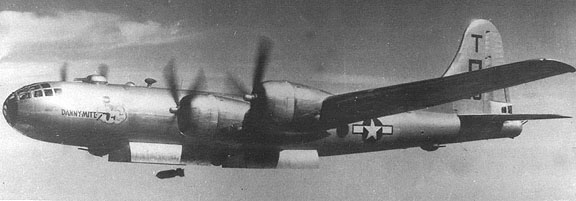
'Dannymite' (44-69777) of the 498th BG in February 1945
Once again the Joint Chiefs called in Curtis LeMay to take over. He had analyzed the Japanese economy and focused on its dependence on small cottage industries spread throughout the large cities. Since the previous afforts at high-level precision, daylight bombing of specific targets had failed, LeMay instead proposed to burn out the Japanese cities entirely, destroying the critical industries (and the civilian population) in the process. (Not exactly the way we wage war now, where every errant bomb that hits an Afghan camel must be accounted for.)
LeMay developed a radically different approach. First, the bombers would carry incendiary, rather than high explosive, bombs. To save fuel and maximize the bomb load, the guns were stripped out, the Superforts would fly at 5,000 (instead of 30,000) feet, and each plane would fly directly to the target (no more circling and joining up in formation). These allowed each Superfort to carry about seven tons of M69 incendiary bombs. Lastly, they would go at night, since precision was no longer required and because Japanese night fighter forces were not very good.
The results were devastating. On the night of March 9-10, 279 B-29's bombed Tokyo. A huge firestorm resulted, sixteen square miles of Tokyo were reduced to ashes and 84,000 Japanese were killed. In the next week, similar, but less destructive, results were obtained in Nagoya, Osaka, and Kobe. Only twenty B-29s were lost. XXI Bomber Command exhausted its supply of incendiaries for a while, but when resupplied in April continued the terrible raids with awesome fury. The industrial areas of Tokyo, Nagoya, Osaka, Kawasaki, Kobe, and Yokohama were reduced to ashes. The aircraft engine factories (or their general areas) were hit again with incendiary bombing. By mid-April, Japanese aircraft engine manufacturing capability had been wiped out. The incendiary raids continued through June, reducing Japans' six largest cities to ashes. Kobe was so thoroughly gutted that it was removed from the target list. B-29 Hunters of the JAAF (Osprey Aviation Elite 5) by Koji Takaki, Henry Sakaida B-29 Hunters of the JAAF
More B-29's arrived in the Marianas, including those from the former XX Bomber Command and some B-29B's, specifically lightened for nighttime pathfinding. The Superfortress missions expanded to include mining the Inland Sea and firebombing 58 smaller cities. The Japanese fighter forces had been routed. Almost unopposed, the B-29's began dropping leaflets three days in advance of their incendiary raids, advising inhabitants of their city's impending destruction.

The Atomic Bomb

Long before the incendiary raids began to devastate Japan, the United States had been developing the atomic bomb. The Manhattan Project, in highest secrecy during 1943 and 1944, built two such bombs, a plutonium bomb dubbed "Fat Man," and a uranium bomb, "Little Boy." The 509th Composite Group was charged with delivering the new bombs, in specially modified B-29's, each capable of carrying and releasing a 10,000 pound atomic bomb. Commanded by Colonel Paul W. Tibbets, Jr., the men of the 509th knew nothing of their proposed mission. Nonetheless, they trained for their secret mission at Wendover, Utah before shipping out to Tinian, where they endured a lot of ribbing from guys in other units, "Oh, yeah, the 509th is gonna win the war."
After the first successful test of an atomic bomb on July 16, 1945 at Alamogordo, New Mexico, planning accelerated, and the Allies were informed, although Soviet spies had already kept Stalin fully apprised of developments. On July 26th, the Potsdam Declaration, an ultimatum which promised prompt and utter destruction, was issued to the Japanese. Well aware of the huge casualties that the Allies would incur in an invasion of Japan and determined to shorten the war, President Truman gave General Carl Spaatz the go-ahead to drop the atomic bomb. "Fat Man" and "Little Boy" were delivered to Tinian by USS Indianapolis and by C-54 transport planes. On August 6, 1945, the Enola Gay dropped "Little Boy" on Hiroshima. 75,000 people died and almost 50,000 buildings were destroyed. (Read more about Tibbets, the Enola Gay, and this mission.)
The Allies had expected, or perhaps hoped, that Japan would surrender after suffering the effects of an atomic bomb. But the Japanese government could not commit itself to surrender so quickly. In part they did not understand what had happened; in Tokyo all that was immediately certain was that all communications with Hiroshima had stopped. While the Japanes cabinet debated, conventional B-29 raids continued, in ever increasing force. Three days later, with no response from the Japanese, we dropped "Fat Man" on Nagasaki. (Personally, I try to avoid second guessing, and I am convinced that dropping the atomic bomb was the right decision, and that it ultimately saved both American and Japanese lives. But I do wonder if we should have let a few more days pass before dropping that second one. I guess by August of 1945, we were tired of war.)
But it worked. That day the Soviets declared war on Japan and invaded Manchuria. The Emperor ordered the government to surrender. He broadcast word of the surrender to the Japanese people on August 15, and it was signed on the decks of the USS Missouri on September 2, 1945.
The B-29's last missions of the war consisted of mercy food drops to POW camps.

Soviet Tu-4

In late 1944, three B-29's had to land in Vladivostok. At the time the Soviet Union was not at war with Japan. The crews were briefly interned, and then permitted to "escape." But the B-29's stayed behind.
In 1947, at a parade in Moscow, the Tu-4 flew over; it was an exact replica of the B-29. In the early years of the Cold War, the Tu-4 gave the American military planners fits, because it was the first Soviet airplane with the capability to drop nuclear bombs on the Unied States.

The Korean War

Within days of North Korea's invasion of the south on June 25, 1950, Superfortresses were attacking Communist troops, tanks, trucks, and other tactical targets. By August, with the war going badly, they were okayed for raids against strategic targets in the north: bridges, rail yards, and factories. After the Inchon landings in September, the B-29's turned again to tactical missions, because UN forces controlled most of North Korea.
The massive Chinese intervention across the Yalu in November changed the war again. As they pushed the UN armies back below the 38th parallel, the B-29's again went after troop concentrations. And Chinese intervention also brought the MiG-15 jet fighter into the conflict; now the B-29's were confronted by an extremely capable interceptor. In early 1951, B-29 losses to the MiGs increased, despite F-80 and F-84 escorts and high altitudes. Eventually, the Superfortresss were limited to night bombing missions, which kept their losses down.
B-29 gunners were credited with downing 27 MiGs, making the aircraft the second-highest scoring aircraft, after the F-86 Sabre. One B-29, Command Decision, shot down five MiGs, making the aircraft an ace of sorts.

Surviving B-29 Aircraft

Relatively few B-29's survive today, in part because (unlike the B-17) they were not declared war surplus after WWII.
Serial number - comment
42-6376 - to storage at Davis Monthan 6/27/49
42-65281, Miss America '62 - at Travis AFB Museum, CA
42-27297, Bock's Car - the Nagasaki bomber, now on display at WPAFB Museum, OH
44-27343 - at Tinker AFB Air Park, OK
44-61975 - at New England Air Museum
44-69729 - on display at Seattle Museum of Flight, WA
44-69972 - stored on range at Naval Air Warfare Center, China Lake, CA, moved to United States Air Museum, Inyokern, CA and is under restoration
44-70016 - at Pima Air Museum, Tucson, AZ
44-70064 - on display at Castle AFB Museum, plane is actually made up of three derelict targets from China Lake
44-84076 - on display at SAC Museum, Offutt AFB, NE
44-86292, Enola Gay - dropped atomic bomb on Hiroshima
44-86408 - used to collect radioactive samples during postwar atomic tests, now on display at Hill AFB Museum
44-87779 - at South Dakota Air and Space Museum, Ellsworth AFB
45-21763, Kee Bird - abandoned after landing frozen lake in Greenland, during to recover, caught fire and burned May 21, 1995. Check out PBS Nova episode about the efforts to recover Kee Bird.
45-21787, Fertile Myrtle - used as carrier aircraft for D-558-II, registered as NACA 137, now with Weeks Air Museum, Miami, FL
45-21800 - used as "mothership" for X-1 trials
45-21801 - used by NACA between 1945 and 1955

Rabu, 15 Juli 2009

DRAGON WORLD WAR 2 SOVIET 1/6 SCALE

DRF70091s.jpg (3734 bytes)

DRF70091"Pavel Nikolaievich Chernov" - Soviet Infantry Officer, 193rd Rifle Division,
Byelorussia, 1944 (Junior Lieutenant)
$49.95
Uniform:
- M1940 Shapka-usanka Cap
- Soviet 1941-pattern Sheepskin Coat
- M1943 Gymnastiorka Tunic (Private)
- Sharovari Trousers - standard
- Officer Riding Boots
Equipment:
- M1943 Officer Equipment Belt
- Water Bottle Cover
- Binocular Case (Leather)
- Binoculars w/ cap
- Water Bottle
- Soviet Mapcase w/ Belt Loops
- Soviet M1895 Nagant Holster
Weapons:
- Nagant M1895 Revolver
Insignia:
- Soviet Red Star Cap Insignia
- M43 Shoulderboard - Junior Lieutenant
Others:
- NEO Male Body
- Men Hands with Gloves
- New character head
- Clear stand mount


12" ACTION FIGURES

DRF70548s.jpg (4391 bytes)

DRA70548.1/6 "Lev Vassilievich Pavlov" - Soviet Naval Infantry Medical Aid Man,
Black Sea Fleet, Sevastopol, 1942 (Sanitarniy) $49.95
Uniform:

- Navy Cap w/ Black Sea Fleet Cap Tally New
- Navy Enlisted Pea Jacket New
- Navy Trousers New
- Navy Infantry "Telnyashka" Striped Pullover Shirt
- Soviet Sapogi Boots NP05

Equipment
- PPsh41 Drum Pouch (Cloth)
- Small Triangular Compressed White Bandage 1
- Small Triangular Compressed White Bandage 2
- Gauze Bandage
- Iodine Swabs
- Ammonia Aromatic Spirit
- Small First Aid Dressing
- Water Bottle Cover
- Water Bottle NP05
- Navy Belt New
- Medical Pouch New
Weapon
- PPsH-41 w/Drum Magazine
Insignia
- Soviet Red Star Cap Insignia
- Red Star for Pea Jacket lower sleeves New
Others
- NEO Male body
- Men Hands with Gloves
- New character head New Sculpture
- Clear stand mount

70407iconS.jpg (4684 bytes)

DRA70407."Ilya Romanovich Mironov" Soviet Anti-Tank Rifle NCO,
Red Army Rifles,Dnieper, Winter 1943 (Senior Sergeant). $49.95

Uniform
- Soviet M40 Helmet
- Winter Cloth Mittens
- Hooded Winter Oversmock
- M43 Gymnastiorka Tunic (Private)
- Sharovari Trousers
- Winter Overtrousers
- Soviet Sapogi Boots
Equipment
- PPSh 41 Stick Magazine Pouch
- PTRD Cartridge Pouch w/ Shoulder Strap
- Soviet EM Belt
- Water Bottle Cover
- Binoculars w/ Strap
- Water Bottle
Weapons
- PTRD-41 Anti-Tank Rifle
- PPSh 43
- PTRD-41 Anti-Tank Rifle Ammunition
- PTRD-41 Anti Tank Rifle Ammo (Metal)
Insignia
- Shoulder Tabs (Senior Sergeant)

70420icon.jpg (11344 bytes)

DRA70420."Sergei Ivanovich Kozlov" Red Army DPM Gunner,
2nd Guards Infantry Division, Sevastopol, May 1944 (Corporal). $45.00

Uniform
SOV M40 Helmet
Cape-plasch palatka
M1943 Gymnastiorka Tunic
Sharovari Trousers
Soviet Sapogi Boots
Equipment
DP Magazine Pan Pouch
Soviet EM Belt, Leather
Gas Mask Bag
Water Bottle Cover
Water Bottle
Weapons
SOV F-1 "Egg" Grenade
DPM Light Machine Gun
DP28 Magazine Drum
Insignia
"Order of Glory" Medal with ribbon, 3rd class
M43 Shoulder boards (Infantry - Corporal)

70285s.jpg (3123 bytes)

DRA70285.VLADIMIR RED ARMY SCOUT, AUSTRIA SPRING 1945 (PRIVATE) $45.00
Uniform:
Pilotka Sidecap (NEW!!)
M43 Gymnastiorka Tunic
Sharovari Trousers (NEW!!)
Late-War Camouflage Coverall (Masksirovochyi Kombinezon) (NEW!!)
Equipment:
PPSh 41 Stick Magazine Pouch (NEW!!)
Red Army Belt
BN Gas Mask Bag
Bayonet for SVT-40 Rifle with Scabbar
Dispatch Case (NEW!!)
M1929 Water Bottle with Cover
Weapons:
PPSh 41 with Banana Type Magazine
Insignia:
Soviet Red Star Cap Insignia

70419s.jpg (3833 bytes)

DRA70419.1/6 "Fyodor Antonovich Nikitin" Soviet Naval Infantryman Red Banner,
Baltic Fleet, Eastern Front 1944 (Corporal)
$45.00
Uniform
- Soviet Navy Fleet Cap (Black Sea Fleet)
- Pacific Fleet Cap Tally
- M1943 Gymnastiorka Tunic
- Sharovari Trousers - standard
- Navy Infantry "Telnyashka" striped Pullover Shirt
- Soviet Sapogi Boots
Equipment
- PPSh41 Drum Pouch (Cloth)
- Soviet EM Belt
- BN Gas Mask Bag
- SVT-40 Bayonet
- Water Bottle Cover
- Scabbard First Pattern
- Water Bottle
Weapons
- Rpg-43 Grenade
- PPsH-41
- PPSH41 Drum Magazine
Insignia
- "Order of Glory" Metal, 3rd class
- Medal for Distinguished Service in Battle
- Order of Patriotic War, 2nd class
- SOV M43 Shoulder Tab (Navy - Corporal)

70210s.jpg (6042 bytes)

DRA70210.Vassily Red Army Tank Commander (Sergeant) WWII Kursk 1943 $45.00

70460bs.jpg (4867 bytes)

DRA70460."Vadim Antonovich Popov & Laika" Soviet Infantry Scout w/Dog,
Operation "Bagration" Belarus 1944.
$54.95
Uniform
- Soviet M40 Helmet
- M1943 Gymnastiorka Tunic
- Amoeba MKK Smock
- Sharovari Trousers - standard
- Soviet Amoeba Over - trousers
- Soviet Sapogi Boots
Equipment
- M1891 Ammo Pouch
- Soviet EM Belt
- BN Gas Mask Bag
- Water Bottle
- Binoculars
- Water Bottle Cover
- Ammo clips for M1891/30 Mosin Nagant
Weapon
- M1891/30 Mosin Nagant rifle
Insignia

- Shoulder Tap (Infantry - Private)
Others
- NEO Male body
- Men Hands
- New character head
- Clear stand mount
- Special Dog "Laika" Resin

DRF70250S.jpg (4745 bytes)

DRF70250."Alexei Petrovich Komarov" - Soviet NKVD Officer Internal Security
Berlin 1945 (Captain) $44.95
Uniform:

Officer Peaked Cap 1935 Pattern
Leather Jacket
M43 Gymnastiorka Tunic
Officer Service Breeches
Officer Riding Boots
Equipment:
M1943 Officer Equipment Belt (Leather)
Tokarev TT-30 Holster (Leather)
M1929 Water Bottle w/Fabric Cover
Dispatch Case (Leather)
Soviet Patriotic Song Book (Paper)
Weapons:
Tokarev TT-30 Pistol
PPsh 43 Sub-Machine Gun


sumber: www.tridentmilitary.com

Senin, 13 Juli 2009

Handley Page Hampden

Specifications (Handley Page Hampden
Type: Four-Seat bomber (later torpedo bomber and minelayer).
Origin: Handley Page
Models: H.P. 52 Hampden I and H.P. 53 Hereford I
First Flight:
Prototype H.P. 52: June 31, 1936
Production Hampden I: May 1938
Production Hereford I: December 1939
Service Delivery: 1939
Production Halted: March 1942
Number Produced:
1,430 Hampdens (Handley Page 500, English Electric 770, Canadian Associated Aircraft 150)
100 Herefords were built by Short Brothers but failed to achieve operational status, many rebuilt as Hampdens.

Engine:
Hampden I
  • Model: Bristol Pegasus XVIII
  • Type: 9-Cylinder air cooled radial
  • Number: Two Horsepower: 1,000 hp
Hereford I
  • Model: Napier Dagger VIII
  • Type: 24-Cylinder air cooled H-type
  • Number: Two Horsepower: 1,000 hp
Dimensions:
  • Wing span: 69 ft. 2 in. (21.98m)
  • Length: 53 ft. 7 in. (16.33m)
  • Height: 14 ft. 4 in. (4.37m)
  • Wing Surface Area: N/A
Weights:
Empty:
  • Hampden: 11,780 lb. (5344 kg)
  • Hereford: 11,700 lb. (5308 kg)
Loaded:
  • Hampden: 18,756 lb. (8508 kg)
  • Hereford: 16,000 lb. (7257 kg)

Performance:
Maximum Speed:
Hampden: 254 mph (410 km/h)
Initial Climb: 980 ft/min (300 m/min)
Service Ceiling: 19,000 ft. (5790m)
Range (Fully loaded): 1,095 miles (1762 km)
Armament:
One .303 in. Vickers fixed forward.
One .303 in. Lewis manually aimed from nose by nav/bomb aimer.
One .303 in. Lewis manually aimed by wireless operator from upper rear position. One .303 in. Lewis manually aimed by lower rear gunner.
By January 1940 both rear positions refitted with twin Vickers and increased firing arcs.
Payload: 4,000 lb. (1814 kg.) of bombs internally

sumber: indoforum.org

Jumat, 03 Juli 2009

de Havilland Mosquito


Specifications (de Havilland D.H.98 Mosquito FB.Mk VI)
Type: Two Seat Fighter Bomber, Reconnaissance & Night Fighter
Design:
de Havilland Design Team
Manufacturer: The de Havilland Aircraft Company, Hatfield and Leavesden, also built by Airspeed, Percival Aircraft and Standard Motors (Canley). Built by de Havilland Aircraft Pty, in Australia and de Havilland Aircraft of Canada.
Powerplant: (Mks II, III, IV and early Vs) Two 1,230 hp (918 kW) Rolls-Royce Merlin 21 engines. (Late FB.Mk VI) Two 1,635 hp (1219 kW) Rolls-Royce Merlin 25 engines. (Mk IX) Two 1,680 hp (1253 kW) Rolls-Royce Merlin 72 engines. (Mk XVI) Two 1,680 hp (1253 kW) Rolls-Royce Merlin 72 or 1,710 hp (1276 kW) Rolls-Royce Merlin 73/77 engines. (Mk 30) Two 1,710 hp (1276 kW) Rolls-Royce Merlin 76 engines. (Mk 33) Two 1,635 hp (1219 kW) Rolls-Royce Merlin 25 engines. (Mk 34/35/36) Two 1,690 hp (1260 kW) Rolls-Royce Merlin 113/114 engines. Many other variants had corresponding Merlins made by Packard.
Performance: Maximum speed 362 mph (583 km/h) at 5,500 ft (1675 m); maximum cruising speed 325 mph (523 km/h) at 15,000 ft (4570 m); service ceiling 33,000 ft (10060 m); initial climb rate of 1,870 ft per minute with a climb to 15,000 ft in 9 minutes 30 seconds.
Fuel: 453 Imp gal (544 US gal) plus provision for a 66.5 Imp gal (79.9 US gal) fuselage tank. (Externally) Up to 200 Imp gal (240 US gal) in 2 × 100 or 50 Imp gal (120 or 60 US gal) underwing droptanks.
Range: 1,650 miles (2655 km) with internal bombload.
Weight: Empty 14,300 lbs (6486 kg) with a loaded take-off weight of 22,300 lbs (10115 kg).
Dimensions: Span 54 ft 2 in (16.51 m); length 40 ft 10 3/4 in (12.47 m); height 15 ft 3 in (4.65 m); wing area 454 sq ft (42.18 sq m).
Armament: Four 20 mm Hispano Mk II cannon with 150 rounds per gun in the lower nose and four 7.7 mm (0.303 in) Browning Mk II machine-guns in the upper nose plus 2,000 lbs (907 kg) of bombs or 1,000 lbs (454 kg) of bombs and eight 60 lbs rocket projectiles.
History: First flight (prototype Mk I) 25 November 1940; first flight (NF.Mk II) 15 May 1941; first flight (T.Mk III) January 1942; first delivery (B.Mk IV) 105 Squadron at Swanton Morley in November 1941.
Operators: Austraila, Belguim, Canada (RCAF), China, Czechoslavakia, France, Yugoslavia, New Zealand, Norway, Soviet Union, Turkey, United Kingdom (RAF, RN, BOAC), United States (AAF).
Number Built: 7,781
Number Still Airworthy: One (Previously airworthy, but has not flown for the last few years.)
Nicknames: Mossie; Balsa Bomber; Wooden Wonder; Freeman's Folly (early nickname referring to Air Council member Sir Wilfred Freeman); Tsetse (Mk XVIII anti-shipping variant).

sumber: indoforum.org

Kamis, 02 Juli 2009

STEALTH AIRCRAFT

REQUEST DARI BEBERAPA PEMBACA

B-2 Spirit stealth bomber

Pesawat siluman (bahasa Inggris: stealth aircraft) atau disebut pesawat amat senyap[1] adalah pesawat yang dirancang untuk menyerap dan membelokkan radar menggunakan teknologi siluman, membuatnya lebih sulit untuk dideteksi. Pada umumnya tujuannya adalah melancarkan serangan selagi dia masih berada di luar pendeteksian musuh. F-117 Nighthawk adalah salah satu jenis pesawat siluman yang digunakan angkatan udara Amerika Serikat dalam Perang Teluk.

Pesawat siluman memiliki kemampuan untuk menghindari pendeteksian, baik deteksi secara visual, audio, sensor panas, maupun gelombang radio (radar). Secara visual, pesawat lebih sulit untuk terlihat bila mempunyai warna yang sama dengan warna latar belakangnya (kamuflase). Secara audio, tentunya berusaha untuk membuat pesawat semakin tenang. Secara sensor panas, pesawat biasanya dideteksi dari panas yang timbul dari badannya atau dari temperatur udara di sekelilingnya. Bagian paling panas dari pesawat biasanya adalah saluran buangan udara mesin atau exhaust dan leading edge (bagian pesawat yang pertama membelah udara). Panas dari exhaust bisa dikurangi dengan cara mencampur semburan mesin dengan udara dingin dari luar badan pesawat sebelum dihembuskan keluar pesawat dan memperpanjang pipa exhaust (seperti A-4 Skyhawk Indonesia yang mempunyai exhaust lebih panjang dibanding versi standarnya). Bagian exhaust ini biasanya dikejar oleh rudal anti-pesawat dengan sensor inframerah. Akan tetapi rudal pencari panas modern kini juga memiliki kemampuan untuk mendeteksi dan mengejar panas yang dihasilkan akibat pergesekan permukaan badan pesawat dengan udara.

Deteksi secara gelombang radio adalah dengan cara mencegah gelombang radio dari radar tidak terpantul dari badan pesawat dan kembali ke radar. Gelombang radio tersebut bisa diserap jika badan pesawat dilapisi RAM (Radar Absorbent Material), dipantulkan ke arah lain, atau sedemikian sehingga gelombang tersebut menjadi hilang atau saling meniadakan (hal inilah yang mendasari bentuk pesawat siluman yang mempunyai bentuk yang lain dari pesawat biasa atau agak aneh).

Pesawat siluman biasanya tidak 100% tidak terdeteksi radar. Tetapi karena memiliki RCS (Radar Cross Section) yang kecil maka di layar radar hanya tampak sebesar gerombolan burung, bukan pesawat.

sumber: wikipedia.org

Gloster Gladiator

Specifications (Gloster Gladiator Mk II)
Type: Single Seat Biplane Fighter
Design: H.P. Folland
Manufacturer: Gloster Aircraft Company
Powerplant: (SS.37) One 645 hp (481 kW) Bristol Mercury VIS radial engine. (Mk I) One 840 hp (626 kW) Bristol Mercury IX or IXS 9-cylinder radial engine. (Mk II) One 830 hp (619 kW) Briston Mercury VIIIA 9-cylinder radial engine.
Performance: Maximum speed 253mph (407km/h); initial climb rate 2,300 ft (700 m) per minute; service ceiling 33,000 ft (10060 m).
Range: (Mk I and II) 440 miles (708 km); (Sea Gladiator) 425 miles (684 km).
Weight: (Mk I and II) Empty 3,450 lbs (1565 kg) with a maximum take-off weight of 4,750 lbs (2155 kg). (Sea Gladiator) Empty 3,745 lbs (1699 kg) with a maximum take-off weight of 5,420 lbs (2459 kg).
Dimensions: (Mk I and II) Span 32 ft 3 in (9.85 m); length 27 ft 5 in (8.38 m); height 10 ft 4 in (3.17 m).
Armament: First 71 aircraft, two 7.7 mm (0.303 in) Vickers machine guns in the fuselage, one 7.7 mm (0.303 in) Lewis machine gun under each lower wing; subsequent aircraft had four 7.7 mm (0.303 in) Browning machine guns in same locations. Fuselage guns had 600 rounds per gun and wing guns had 400 rounds per gun.
Variants: Gloster SS.37 (prototype), Gloster Gladiator, Gloster Gladiator Mk I, Gloster Gladiator Mk II, Gloster Sea Gladiator.
Avionics: None.
History: First flight (SS.37) September 1934; (Gladiator 1) June 1936; (Sea Gladiator) 1938; service delivery March 1 937; final delivery April 1 940.
Operators: Belgium, China, Egypt. Finland, Greece, Iraq, Ireland, Latvia, Lithuania, Norway, Portugal, South Africa, Sweden, UK (RAF, RN).

sumber:indoforum.org

Fairey Firefly

Specifications (Fairey Firefly AS.Mk 5)
Type: Two Seat Naval Reconnaissance Fighter / Anti Submarine Strike Aircraft
Design: Fairey Aviation Design Team
Manufacturer: The Fairey Aviation Company
Powerplant: (AS.Mk 5) One 2,250 hp (1678 kW) Rolls-Royce Griffon 74 12-cylinder Vee piston engine. (Mk I up to No 470) One 1,730 hp (1290 kW) Rolls-Royce Griffon IIB 12-cylinder Vee liquid-cooled; (from No 471) 1,990 hp (1485 kW) Griffon XII. (Mks 4-7) One 2,250 hp (1678 kW) Griffon 74 12-cylinder Vee piston engine.
Performance: (AS.Mk 5) Maximum speed 386 mph (618 km/h) at 14,000 ft (4265 m); cruising speed 220 mph (354 km/h); service ceiling 28,000 ft (8534 m). (Mk I) Maximum speed 316 mph (509km/h); initial climb rate 1,700 ft (518m) per minute; service ceiling 28,000 ft (8534 m). (Mk 4) Maximum speed 386 mph (618 km/h); initial climb rate 2,050 ft (625 m) per minute; service ceiling 31,000 ft (9450 m).
Range: (AS.Mk 5) 1300 miles (2092 km) on internal fuel. (Mk I) 580 miles (933 km) on internal fuel. (Mk 4) 760 miles (1223 km) on internal fuel.
Weight: (AS.Mk 5) Empty 9,674 lbs (4388 kg) with a maximum take-off weight of 16,096 lbs (7301 kg). (Mk I) Empty 9,750 lbs (4422 kg) with a maximum take-off weight of 14,020 lbs (6359 kg). (Mk 7) Empty 11,016 lbs (4997 kg) with a maximum take-off weight of 13,970 lbs (6337 kg).
Dimensions: (Mk 4 - 6) Span 41 ft 2 in (12.55 m); length 37 ft 11 in (8.51 m); height 14 ft 4 in (4.37 m); wing area 330.0 sq ft (30.66 sq m). (Mk I - III) Span 44 ft 6 in (13.55m); length 37 ft 7 in (11.4 m); height 13 ft 7 in (4.15 m).
Armament: (Mk I) Four fixed 20 mm Hispano cannon in wings and underwing racks for up to two 1,000 lbs (454 kg) of bombs or sixteen 60 lbs (27 kg) rocket projectiles. (Mk 4 and 5) usually similar to 1 in most sub-types. (Mk 6) no guns, but underwing load increased to 3,000 lbs (1362 kg) and varied. (Mk 7) no guns, but underwing load remained at 3,000 lbs (1362 kg) and equipment changed.
Variants: Firefly F.Mk 1, Firefly FR.Mk 1, Firefly F.Mk IA, Firefly NF.Mk 11, Firefly NF.Mk I, Firefly T.Mk 1, Firefly T.Mk 2, Firefly T.Mk 3, Firefly F.Mk III, Firefly F.Mk IV, Firefly FR.Mk 4, Firefly TT.Mk 4, Firefly Mk 5, Firefly Mk 6, Firefly FR.Mk 5, Firefly NF.Mk 5, Firefly AS.Mk 5, Firefly AS.Mk 6, Firefly TT.Mk 5, Firefly TT.Mk 6, Firefly, AS.Mk 7, Firefly T.Mk 7 ASW, Firefly U.Mk 8, Firefly U.Mk 9.
Avionics: AI Mk X radar, ASH Scanner, sonobuoys.
History: First flight 22 December 1941; first production F.1 26 August 1942; production FR.4. 25 May 1945; final delivery of new aircraft May 1955.
Operators:United Kingdom (RN), Canada (RCN), Australia.
Number Built: ~1533

sumber: indoforum.org

Boulton Paul P.82 Defiant

Specifications (Boulton Paul Defiant Mk II)
Type: Two Seat Night Fighter
Design: Boulton Paul Design Team
Manufacturer: Bolton Paul Aircraft, Wolverhampton.
Powerplant: (Mk II) One 1,280 hp (954 kW) Rolls-Royce Merlin XX inline piston engine. (Mk I) One 1,030 hp (768 kW) Rolls-Royce Merlin III Vee 12-cylinder piston engine.
Performance: Maximum speed 313 mph (504 km/h) at 19,000 ft (5790 m); cruising speed 260 mph (418 km/h); service ceiling 30,350 ft (9250 m); initial climb rate 1,900 ft (579 m) per minute.
Range: 465 miles (748 km) on internal fuel.
Weight:
(Mk II) Empty 6,282 lbs (2849 kg) with a maximum take-off weight of 8,424 lbs (3821 kg). (
Mk I) Empty 6,078 lbs (2757 kg) with a maximum take-off weight of 8,350 lbs (3787 kg).
Dimensions:
Span 39 ft 4 in (11.99 m);
length 35 ft 4 in (10.77 m);
height 11 ft 4 in (3.45 m);
wing area 250.0 sq ft (23.23 sq m).
Armament: Four 7.7 mm (0.303 in) Browning machine-guns in a hydraulically operated dorsal turret with 600 rounds per gun.
Variants: Boulton Paul P.82 Defiant (prototype),
Defiant F.Mk I, Defiant NF.Mk IA, Defiant Mk II, Defiant TT.MK I, Defiant TT.MK III.
Avionics: AI Mk IV or Mk VI radar, Mandrel jamming system.
History: First flight (prototype) 11 August 1937; (production Mk 1) 30 July 1939; first delivery December 1939.
Operators: RAF.

sumber: indoforum.org

Rabu, 01 Juli 2009

"PEMBOM YANG GANAS"

"Boeing B-17 Flying Fortress" adalah sebuah pesawat pengebom mlik Amerika Serikat,yang khusus dibuat untuk US Army Air Corps. Pesawat ini mulai mengangkasa pada tanggal 28 juli 1935,dan dipensiunkan pada tahun 1968. Sekitar 12.000 B-17 diproduksi yang digunakan sebagai pembom strategis pada perang dunia 2 melawan jerman(NAZI).Hampir 1/3 dari total bom yang dijatuhkan di jerman,adalah yang dijatuhkan oleh B-17.
B-17 mampu melesat dengan kecepatan maksimal 287 mph dan mampu membawa bom hingga 17.600 ponds.Versi terakhir yang dibuat adalah "boeing B-17G flying Fortress" yaitu dengan penambahan senapan mesin pada bagian pipi yang berguna untuk menambah daya tangkal terhadap luftwaffe.
B-17 terkenal dengan sebutan "sekumpulan badak" oleh pilot2 jerman karena B-17 adalah bomber yang paling sulit ditumbangkan daripada bomber lainnya seperti:Avro Lancaster(inggris),Short Sterling(inggris),Halifax(inggris),Consolidated B-24 Liberator(USA).
Specifications (B-17G):
Engines: Four 1,200-hp Wright R-1820-97 Cyclone turbocharged radial piston engines

Weight: Empty 36,135 lbs., Max Takeoff 65,500 lbs.
Wing Span: 103ft. 9in.
Length: 74ft. 4in.
Height: 19ft. 1in.
Performance:
Maximum Speed at 25,000 ft: 287 mph
Cruising Speed: 182 mph
Ceiling: 35,800 ft.
Range: 2,000 miles with 6,000 lb. bomb load
Armament:
13 12.7-mm (0.5-inch) machine guns
Up to 17,600 pounds of bombs

Senin, 29 Juni 2009

MESIN TERBANG SEKUTU (WW2)

SEKUTU (AMERIKA SERIKAT,INGGRIS,RUSIA):

AMERIKA SERIKAT


Douglas A-1 Skyrider

Douglas A-26 Invader

Douglas SBD Dauntless

Grumman F4F Wildcat

Grumman F6F Hellcat

North American P-51D Mustang

P-38 Lightning

Grumman TBF Avenger
Grumman F8F Bearcat

Grumman F7F Tigercat

P-47 Thunderbolt

INGGRIS


Supermarine Spitfire

Hawker Sea Fury

Hawker Hurricane

Fairey Firefly

RUSIA


Yakovlev Yak-9

Yakovlev Yak-3

Polikarpov I-16